Walk through a Buccaneers tailgate today and you will still find jerseys in a color the team has not worn as its primary look since 1996: a bright orange that fans and media long ago nicknamed "creamsicle." The team that wears it now has two Super Bowl trophies and a modern pewter and red identity. And yet, when the Buccaneers bring the orange back for a single game a season, it is often the biggest jersey-related story of that week. To understand why, you have to go back to a logo drawn by a cartoonist, a losing streak that outlasted a decade, and an ownership change that eventually let the past become fashionable again.
A pirate with a knife in his teeth
When the NFL awarded Tampa Bay its expansion franchise in the mid-1970s, the team needed a look before it needed wins. Lamar Sparkman, an artist and cartoonist at the Tampa Tribune, designed the original logo: a grinning pirate in a plumed hat, a dagger clenched in his teeth, one eye closed in a wink. Sparkman said he drew inspiration from swashbuckling figures like Errol Flynn and the pirate Jean Lafitte, and that the plumed hat was meant to add class while the dagger added aggression. The logo became known as "Bucco Bruce," and it sat on a white helmet trimmed in orange and red stripes.
The uniform built around that helmet used "Florida Orange" as its primary jersey color, paired with white pants carrying thin orange and red stripes, or the reverse depending on the game. It was unlike almost anything else in the NFL at the time, bold enough to be memorable even when, as the 1976 and 1977 Buccaneers proved almost immediately, there was very little winning football happening underneath it.
Winning finally arrives, in flashes
The creamsicle uniform's best moments came early. The Buccaneers reached the NFC Championship Game in the 1979 season, their fourth year of existence, before losing to the Los Angeles Rams. Two years later, in 1981, Tampa Bay went 9-7 and won the NFC Central division again, only to be shut out 38-0 by the Dallas Cowboys in the divisional round, a result that remains one of the most lopsided losses in playoff history.
The strike-shortened 1982 season brought one more brief flash: a 5-4 record was good enough, under that year's expanded playoff format, to send Tampa Bay back to the postseason, where the Buccaneers lost a close, contentious wild card game at Dallas, 30-17. It was the last playoff appearance the creamsicle uniform would ever see.
Three good years in twenty-one
SeasonRecordResult
1979
10-6
NFC Central champions, lost NFC Championship Game 9-0 to the LA Rams
1981
9-7
NFC Central champions, lost divisional round 38-0 to Dallas
1982
5-4
Made the strike-format playoffs, lost wild card round 30-17 at Dallas
Those three seasons were the entire competitive output of the creamsicle uniform. Everything else, eighteen of twenty-one seasons, ended without a playoff berth. Quarterback Doug Williams, drafted in 1978, was the offensive engine behind the 1979 and 1981 division titles, paired with a defense anchored by Lee Roy Selmon, the team's first-ever draft pick and eventual Hall of Famer. When Williams left the team after a contract dispute following the 1982 season, the offense that had carried those good years left with him.
The long losing stretch that defined the eighties
What followed was one of the bleakest runs any NFL franchise has endured. Williams sat out the entire 1983 season rather than accept owner Hugh Culverhouse's contract offer, and without him Tampa Bay collapsed to 2-14 that year. It was the start of fourteen consecutive losing seasons, from 1983 through 1996, thirteen of which saw the team lose at least ten games. The only relief inside that stretch was a 7-9 finish in 1995. The Buccaneers did not have another winning season until 1997, and did not return to the playoffs until that same year, fourteen years after their last postseason trip in the creamsicle jerseys.
Hugh Culverhouse, the attorney and investor who had owned the franchise since its founding, was widely credited around the league for his role in NFL business matters even as his own team struggled on the field year after year. He sat on multiple league committees, handled player grievances leaguewide, negotiated through the 1982 and 1987 players' strikes, and helped bring Super Bowl XVIII to Tampa in 1984. Commissioner Paul Tagliabue later credited him with building much of the strength of the modern NFL's business operations.
That reputation for smart business did not translate to popularity in Tampa. Culverhouse was seen locally as prioritizing profit over winning, most visibly in his refusal to meet Doug Williams' contract request after the 1982 season, and fans and press increasingly viewed the team as a moneymaker run by an owner unwilling to spend what it took to compete. The Buccaneers were reportedly among the NFL's most profitable franchises even during a 5-11 season in 1989, a contrast that did not sit well with a fan base watching the same team lose year after year. Culverhouse died of lung cancer in August 1994, and ownership passed to a group of trustees who put the team up for sale.
A new owner, and the beginning of the end for orange
In January 1995, Tampa businessman and shopping-mall developer Malcolm Glazer bought the Buccaneers for what was then a record price for an NFL franchise, 192 million dollars. Glazer inherited a team that had reached the postseason only three times in nearly twenty years, wearing a uniform that, by the mid-1990s, was closely associated with all of those losing seasons rather than with the brief good ones.
The Glazer ownership moved quickly to change the franchise's image. Ahead of the 1997 season, the Buccaneers retired the orange and white color scheme and the Bucco Bruce logo entirely, switching to pewter and red with a new "skulls and swords" flag logo. New head coach Tony Dungy led the redesigned team to a 10-6 record and the franchise's first playoff win since 1979, beating Detroit in the wild card round before losing to Green Bay in the divisional round. The creamsicle era, twenty-one seasons of orange, was over, and the pewter identity Glazer's franchise built went on to win Super Bowl XXXVII following the 2002 season, then Super Bowl LV following the 2020 season, the payoff on an investment that had looked questionable in January 1995.
Why the throwbacks became an event
For most of the 2000s and 2010s, the creamsicle look was mostly a memory, kept alive by old photos and the occasional throwback game. The Buccaneers brought the jerseys back briefly in 2009, a moment design writers noted meant enough to Sparkman himself, then 88 years old, that he reportedly said he was very happy to see his creation return; he died a few months later. The orange also reappeared for a game in 2012, complete with the Bucco Bruce helmet, before a league policy that took effect in 2013 limited teams to a single helmet shell per season, making a full historically accurate throwback impossible for the Buccaneers to wear alongside their current pewter helmet.
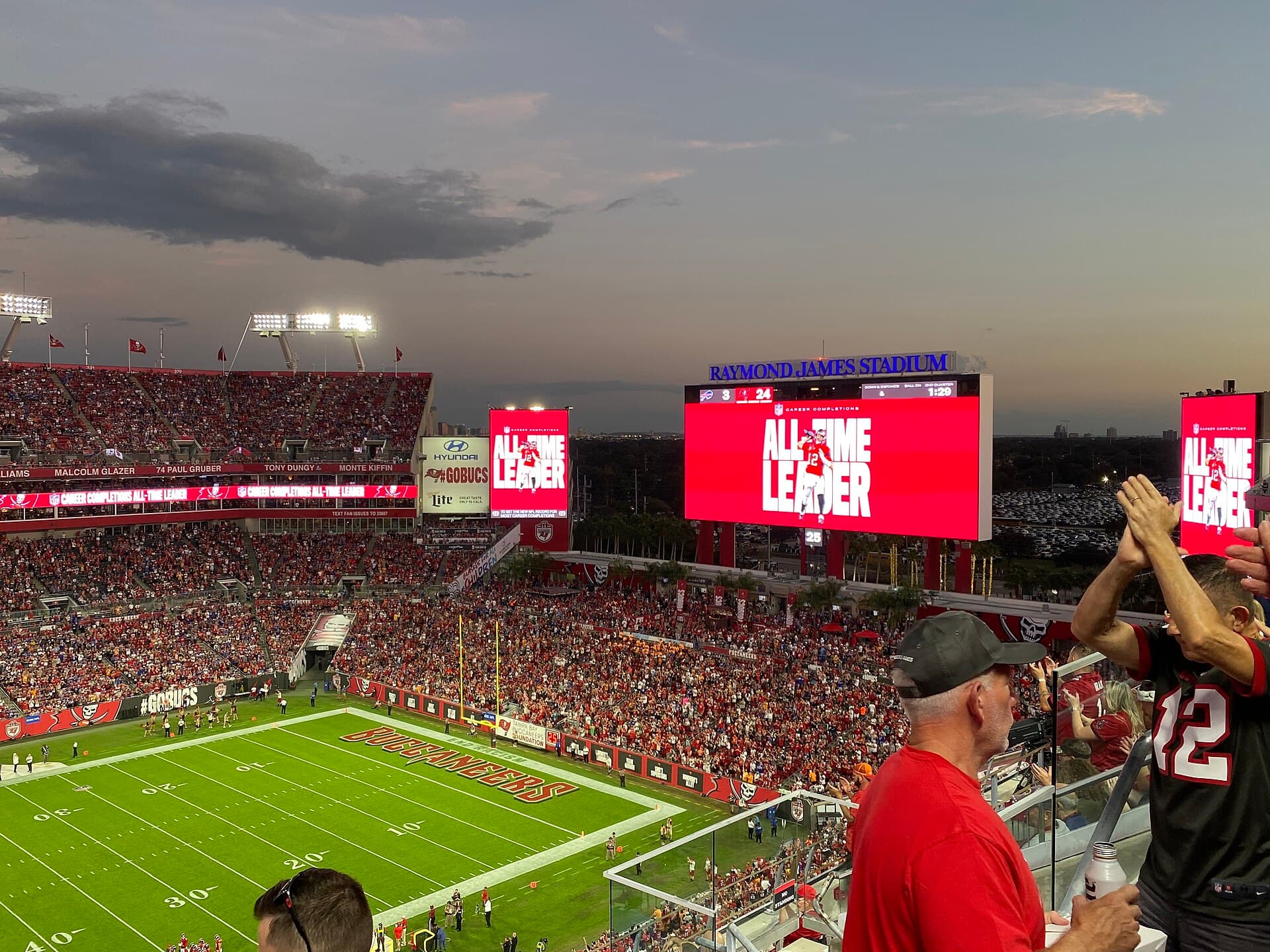
That changed when the NFL rescinded the one-helmet rule in the summer of 2021, following years of lobbying from several teams, Tampa Bay's ownership among them. Buccaneers co-owner Joel Glazer had publicly pushed for the change at league meetings. Supply chain issues pushed the Buccaneers' actual return back further, and the team did not wear the creamsicle uniform, Bucco Bruce helmet included, again until October 15, 2023, against the Detroit Lions at Raymond James Stadium. It was the first time since 2012 that Tampa Bay had worn the old helmet logo in a game. The team brought the uniform back again in 2024, wearing it on October 27 against the Atlanta Falcons, part of a wider trend across the league of teams reviving old looks now that the helmet restriction was gone.
Reaction split along generational lines. Longtime fans and much of the national media treated the return as a genuine event, with heavy coverage from outlets including ESPN and the NFL's own website, and the games generated significant social media attention. Other fans, more attached to the pewter identity built around the franchise's Super Bowl era, have been cooler on wearing orange as anything more than a once-a-year novelty. [CHECK: any measurable data on merchandise sales or jersey purchases tied to the 2023 or 2024 creamsicle games]
Why the orange endures
The creamsicle uniform was never associated with sustained winning. Its best years amounted to three good seasons wedged between a historically bad start and a historically long losing stretch. By most conventional logic, that should make it a color scheme fans would rather forget.
Instead, the orange has become something closer to a family heirloom: a visual shorthand for the era when this franchise was new, strange looking and, for a while, genuinely lovable in its ineptitude before it became a serious contender. Bucco Bruce's wink is not the logo of a champion. It is the logo of a team that existed before anyone expected much of it at all, worn now by a fan base old enough to remember losing seasons and young enough to have only heard about them, both groups happy to put the color back on for one Sunday a year.
For fans following the Buccaneers from outside the United States, many of whom only started paying attention during the Super Bowl years, the creamsicle jerseys work as a shortcut into fifty years of history in a single image. One look at Bucco Bruce, and a newer fan is one Google search away from learning about a 26-game losing streak, a defensive end from Oklahoma who carried a bad team on his shoulders, and a franchise that spent two full decades in orange before it ever spent one in a Lombardi Trophy parade. That is a lot of history for one helmet to carry, and it carries it well.